Key Takeaways
- Amazon Prime Video and ESPN tested simultaneous multi-angle feeds during live games in 2024–2025, with roughly 60% of viewers choosing a non-traditional broadcast option
- Sportradar deployed AI commentators in 2025 — one MLS game, six distinct audio tracks (formal English, casual Spanish, tactical coaching, kid-friendly, accessibility-first), no additional production crew
- Multi-perspective broadcasts increased engagement retention 18% in Disney's internal tests, but live sports viewership still declined 2–4% annually in the same period
- The sports industry has not solved how to monetize personalized broadcasts — dynamic ad insertion, creator revenue splits, and subscription fragmentation are all being tested without a proven model
- The deeper risk isn't technical failure. It's that personalization destroys the shared cultural moment that made sports worth watching together
Part 1 of this series documented the data gap: stadiums collect millions of precision metrics per game while broadcasts show almost none. Part 2 showed the AI systems closing that gap — win probability overlays, automated highlights, viewer-chosen camera angles. Part 3 explored the endpoint: spatial computing, neural interfaces, and immersive environments where the viewer is inside the information, not watching it.
This article asks the question those three left unanswered: when you can make a different broadcast for every single fan, should you? And if you do — what actually breaks?
How is personalized sports viewing different from today's broadcast?
Today, every viewer sees the same broadcast. AI personalization means machines generate a custom feed for each viewer — different camera angles, commentary, stats density, and pacing — based on watching history and stated preferences.
The difference isn't a choice between two or three pre-built feeds. It's machines generating custom broadcasts in real time, tuned to individual engagement patterns. Different camera angles based on what you rewound last time. Commentary style chosen from AI-generated options. Graphics density adjusted to your viewing history. Pacing modified by your pause-and-rewatch behavior. Same game capture. Radically divergent viewer experiences.
Part 2 covered the components that exist in isolation — Prime Vision's tracking overlay, MLS Season Pass's camera choice, Sportradar's automated highlights. This article is about what happens when those components integrate and the broadcast itself becomes a generated artifact, not a produced one. That's a different question, and a harder one.
What do personalized feeds actually look like for different viewers?
A fantasy football player sees snap-by-snap stat overlays and scoring-opportunity commentary. A casual viewer gets compressed highlights and light commentary. A tactical viewer gets defensive alignment breakdowns and coverage rotation analysis. Same game, three incompatible broadcasts.
Amazon Prime and ESPN tested simultaneous broadcasts during the 2024–2025 season. Each viewer could choose a traditional feed, a player-tracking focus, or a tactical-analysis perspective. The fantasy player sees real-time position tracking, per-play stat integration, and commentary focused on yards after contact and target depth. When a run play happens, the fantasy feed says "5.8 yards-after-contact, above the 72nd percentile for that back this season." The casual viewer hears "Great run by the back." They watched the same play. They got different information.
The coach watches a tactical feed with defensive alignment overlays, formation identification, and gap-discipline analysis. The international viewer gets localized commentary with cultural context — when a touchdown is scored, a Spanish-language feed adds historical framing for viewers who aren't saturated in NFL history. The young viewer gets Gen-Z-inflected commentary and viral-clip-optimized editing.
Sportradar demonstrated the production economics in 2025: one MLS game captured as raw footage, software generating six broadcast feeds in distinct styles — formal English, formal Spanish, casual Spanish, kid-friendly, tactical coaching, and accessibility-first — with no additional production crew. Latency: under 30 seconds for AI-generated audio tracks. Total additional production cost: roughly 15–20% above a single-feed broadcast.
Is this actually being deployed, or is it still prototype territory?
It's deployed. Amazon Prime Video, ESPN, and Sportradar all ran documented personalization experiments in 2024–2025 with measurable results.
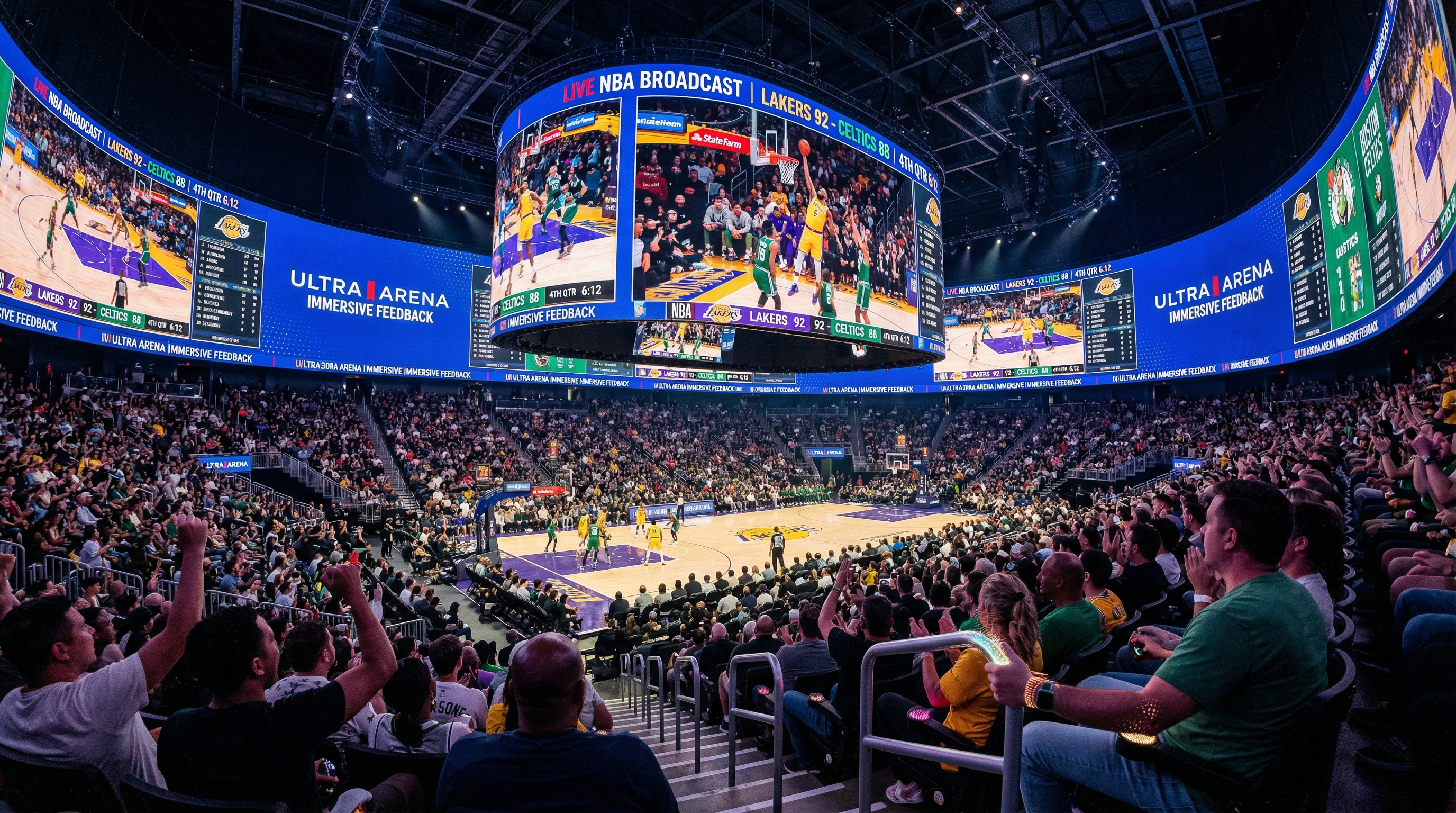
Amazon Prime tested multi-angle NFL viewing during the 2024–2025 season. AWS EventBridge infrastructure generated 15+ parallel broadcast feeds from a single game signal. Prime documented three feed options: traditional broadcast, enhanced player tracking, win-probability emphasis. The viewer split was roughly 40% traditional, 30% player-tracking, 30% analytical — meaning the majority of viewers who had a choice chose something other than the standard broadcast.
The versioning cost was not linear. Producing two additional broadcast perspectives added approximately 15–20% to total production cost, not 200%. AI commentary generation reduced audio production crew requirements from four to five people per game to one to two for quality control.
ESPN+ ran similar tests with select NBA games in Q4 2025 — independent commentary tracks and alternate graphics packages for player-focused and tactical feeds. Disney's internal metrics showed engagement retention 18% higher when viewers selected personalized feeds versus the forced traditional broadcast.
Sportradar's 2025 MLS AI commentary deployment is the most documented case. A single game produced commentary in six distinct voices and styles, driven by large language models trained on archive broadcasts and style guidelines. Production cost per game dropped 60–80% compared to a full human broadcast crew. The trade-off: AI commentary runs 5–7 seconds delayed versus live human commentary. That's acceptable for streaming; it remains a barrier for traditional broadcast.
| Organization | Year | Technology Tested | Result |
|---|---|---|---|
| Amazon Prime Video | 2024–2025 | Multi-angle NFL feeds (3 simultaneous perspectives) | 60% chose non-traditional feed; ~15–20% production cost increase per additional feed |
| ESPN+ (Disney) | Q4 2025 | Independent commentary per feed (NBA test) | 18% engagement retention improvement |
| Sportradar / MLS | 2025 | AI-generated commentary (6+ styles per game) | 60–80% production cost reduction; 5–7 second latency acceptable for streaming |
| MIT Media Lab + ESPN | 2024–2025 | Viewer preference engine (prototype) | Prototype functional; not yet deployed at scale |
What happens when every fan watches a fundamentally different game?
The shared cultural experience of sports fractures. Fans no longer have a common broadcast to reference. Post-game conversation requires disclosing which version you watched. The collective moment — the thing that made sports worth watching together — erodes.
Consider the 1998 NBA Finals. Michael Jordan's game-winning shot against the Utah Jazz was witnessed by 29.8 million viewers. Same camera angle. Same commentary. Same call. That moment entered collective memory because everyone experienced it identically. It became cultural shorthand — a reference point that required no explanation.
Personalization ends that. The fantasy player and the casual fan watching the same game in 2030 may be watching something so different that post-game conversation requires disclosure: "Which feed were you on?" The tactical viewer may have never seen the angle that captured the iconic moment. The international viewer heard it described in different terms.
This isn't necessarily worse, in a strict engagement sense. The 18% retention improvement is real. Personalized experiences feel less like a product you're forced to consume and more like a service tuned to you. But the aggregate cultural value of sports — the shared narrative that built fanbases, justified broadcast deals, and generated the premium that leagues monetize — depends on common reference points. You can't have a water-cooler moment if everyone watched a different broadcast.
What does the engagement data actually say?
Personalized feeds improve per-viewer retention metrics, but live sports viewership still declined 2–4% annually through 2025. The two numbers aren't contradictory — they measure different things.
Nielsen Sports data shows live sports viewership declined 2–4% annually since 2024, even during the same period when personalization pilots were reporting 18% retention improvements. The apparent contradiction resolves when you separate the metrics: per-viewer engagement time went up. Total viewers went down.
One explanation: when everyone watched the same broadcast, sports was appointment viewing. You gathered to watch — with family, with friends, at a bar. Personalization makes it individual. That's higher engagement per person but potentially lower shared-experience engagement — fewer people watching together. The group watch party at a sports bar is premised on a common broadcast. Everyone sees the same thing. That premise breaks when every phone in the room is running a different feed.
The leagues face a direct trade-off. Maximize per-viewer engagement (personalization wins) or preserve the shared-experience premium that made sports uniquely valuable in the first place (traditional broadcast preserves it). The current evidence suggests you can't fully optimize for both simultaneously.
The fragmentation paradox
A 50% increase in per-viewer watch time paired with a 40% decrease in total live audience is a net loss, not a win. Sponsors pay premium rates for sports broadcasting because of reach and cultural resonance — not because sports fans are technically engaged longer. If personalization fragments the audience into millions of siloed experiences, the sponsorship premium that funds production erodes even as engagement metrics improve. That's the economics paradox leagues haven't solved.
The deeper issue is structural. Broadcast rights deals are negotiated on the premise of a unified, captive audience delivered to sponsors. Traditional scarcity — one game, one time, one broadcast — justified the prices. Personalization creates abundance: infinite versions of the same game, each less valuable to advertisers because each reaches fewer people in a shared context. Dynamic ad insertion can target a viewer precisely, but precision targeting has never commanded the same premium as mass reach. The Super Bowl ad market exists because 100 million people see the same 30-second spot. That market doesn't survive a world where 100 million viewers each have a custom ad experience — even if each ad is theoretically more relevant.
None of this means personalization fails. It means the leagues, platforms, and advertisers haven't yet built the economic model to capture its value. That model will take the rest of this decade to sort out.
How will leagues handle economics if every viewer gets a custom broadcast?
Leagues are testing three models: dynamic ad insertion tied to viewer preference data, subscription tier fragmentation with premium personalization gated behind higher prices, and creator revenue splits for AI-generated commentary in identifiable voices. None have proven out at scale.
Traditional broadcast economics depended on scarcity: one game, one time, one audience. Advertisers paid premium rates because they reached a unified, captive group. That scarcity is gone when 30 simultaneous feeds exist.
Ad insertion in personalized broadcasts is still unsolved. If one viewer skips highlights and watches only their team's drives, how do you deliver an ad for a product the viewer actually buys? If another viewer gets AI commentary generated in the voice of a former player — deepfake-adjacent technology that leagues are already licensing — who owns the broadcast and its sponsorship rights? The former player? The league? The AI company?
Leagues are exploring dynamic ad insertion (ads chosen per viewer based on preference data), creator revenue splits (if commentary is generated in a recognizable coach's or analyst's voice, they receive a licensing cut), and subscription tier fragmentation (basic feeds free, premium personalization behind a paywall). None of these are proven at scale. The risk is real: if leagues commit to personalization before the monetization model is settled, they could give away a premium product at commodity pricing while simultaneously degrading the shared-experience value that generated premium pricing in the first place.
What's next
Parts 1–4 have covered the data infrastructure, the AI production layer, the spatial computing shift, and the personalization economics. The next four parts move into physical and business territory.
Part 5 covers mirror stadiums — COSM, the Sphere in Las Vegas, and the emerging category of immersive venues where the physical space becomes the broadcast. Parts 6, 7, and 8 examine your AI director, the rights battlefield, and a speculative look at what sports could look like in 2036 if all these trends converge.
Sources
- Amazon Prime Video Engineering — Multi-Angle Sports Streaming and AWS EventBridge integration (2024–2025)
- Sportradar Media Solutions — AI Commentary Deployment for MLS Season (2025)
- Disney Q4 2025 Earnings — ESPN+ personalization metrics and engagement data
- MIT Media Lab — Viewer Preference Engine research studies (2024–2025)
- Nielsen Sports — Live Sports Viewership Report (2025)
- Deloitte Technology, Media and Telecom Predictions — Sports Broadcasting Personalization (2025)
- Amazon Web Services — NFL Next Gen Stats and parallel feed generation infrastructure
Related Articles on Nexairi
Fact-checked by Jim Smart