Who should pay for AI's power infrastructure?
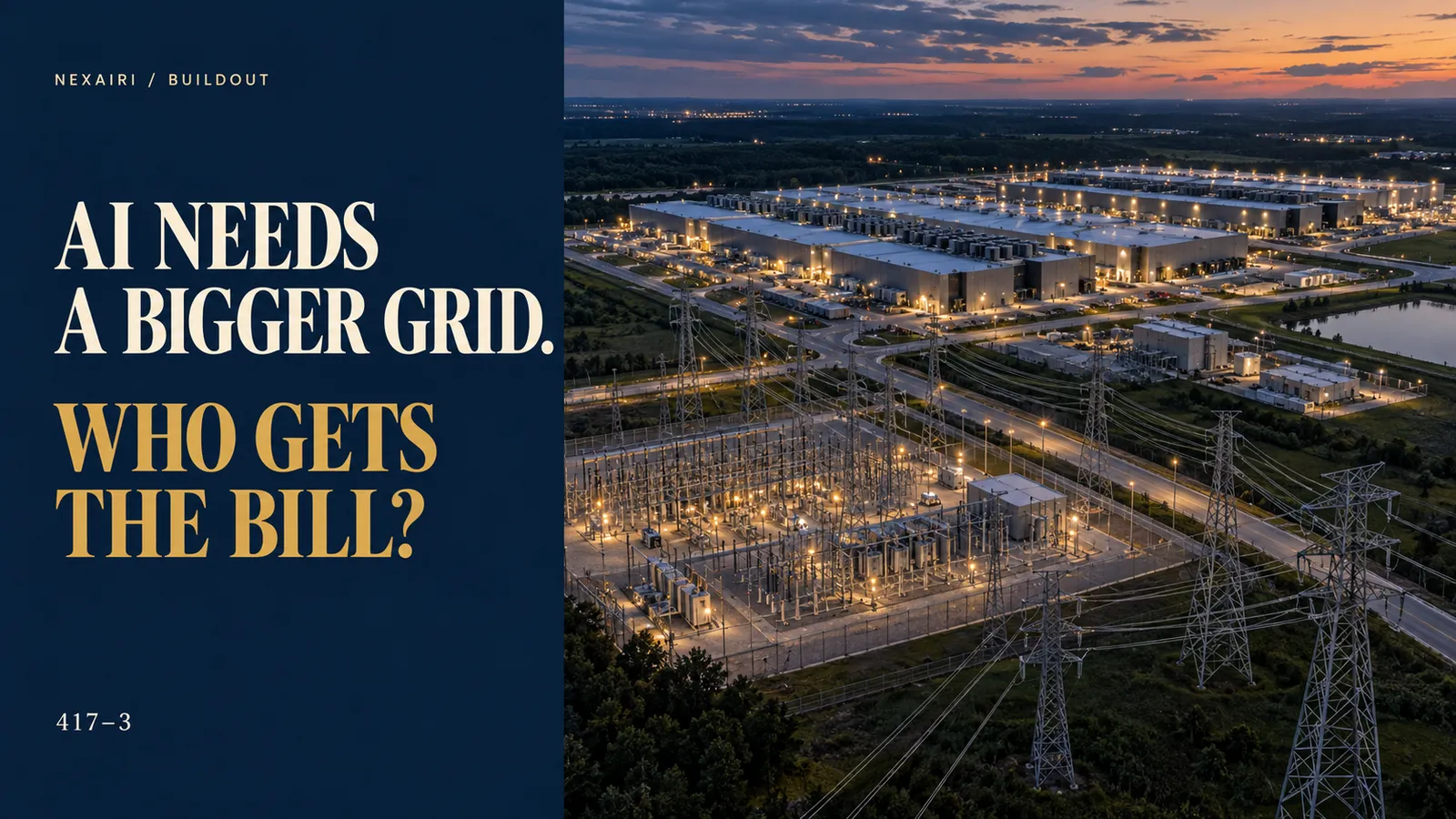
Washington just answered a hard question about AI. The U.S. House voted 417 to 3 to make data centers pay for their own power infrastructure.
For most of the AI boom, electricity has been framed as a supply problem: can utilities generate enough power, get developers connected to the grid and build transmission lines fast enough? Those questions still matter. But on Wednesday night, Washington moved a different one to the center of the debate: who should pay for all of it? The vote was not close, and that margin may matter more than the bill itself.
What does the Ratepayer Protection Act actually do?
The Ratepayer Protection Act pushes state regulators toward one rule. Data centers using 100 megawatts or more should cover the new grid infrastructure they require.
The bill directs state utility regulators to consider a standard requiring large data centers to cover the full incremental cost of the generation, transmission and distribution built to serve them. States keep their existing authority over electricity rates, so this is not Washington setting a national data-center tariff. It is still a clear signal about where the politics are heading, and the Senate has not yet passed its own version.
Why wasn't the grid ever free?
The grid was never free. Someone always pays for the substations, transmission lines and generation a huge new customer requires before it can switch on.
A very large AI campus can require new substations, transmission upgrades and generation capacity before a single GPU does useful work. Utilities normally recover that investment through rates charged to customers. When one enormous new customer needs billions of dollars in added infrastructure, the question of how much cost stays with that customer, and how much spreads across everyone else, used to stay buried inside routine utility filings. AI changed the scale enough that it couldn't stay buried anymore.
| Approach | Who carries the cost | Who carries the risk if demand doesn't materialize |
|---|---|---|
| Spread across all ratepayers | Every household and business on the grid | Existing customers and the utility |
| Attached to the data center | The company that needed the power | The data-center developer |
What happens when a canceled data center leaves the infrastructure behind?
A canceled data center can leave the infrastructure behind. Utilities build ahead of demand, and if the project disappears, the bill and wires do not.
Picture a developer proposing a huge AI campus. The utility plans new infrastructure around it: transmission work begins, a substation expands, generation gets contracted. Then the economics shift. The developer shrinks the project, moves it elsewhere or never builds it at all. The data center vanishes from the forecast. The power infrastructure doesn't vanish with it, and someone still has to carry that cost. That is the risk-allocation question sitting underneath this whole debate, and the House vote suggests where lawmakers want that risk to land: on the developer, not the neighborhood.
Does this make AI campuses more expensive to build?
Yes, in some cases. Attaching more grid cost to a project can make marginal campuses harder to justify, and that may be a healthy filter.
One of the strangest features of the current buildout is the gap between projects that get announced and projects that actually operate. A campus can secure land, enter the interconnection queue and sign preliminary agreements without a single server ever drawing power. Nexairi has tracked this "ghost demand" pattern in Texas, where requested grid connections add up to far more electricity than will likely ever get built. Making developers carry more of the infrastructure bill themselves gives forecasts a reason to get more honest.
Why did 417 lawmakers agree on anything?
Congress rarely agrees on anything 417 to 3. That number says public pressure on data-center costs crossed from a local fight into a national one.
An AP-NORC Center for Public Affairs Research and Energy Policy Institute poll found nearly two-thirds of Americans are extremely or very concerned that data centers will raise their energy prices, and 57% are similarly concerned about the effect on water supplies. The EIA projects U.S. electricity consumption will hit record highs in both 2026 and 2027, with AI and crypto data centers among the main drivers. Those two facts, rising bills and rising public worry, are what turned a niche utility-regulation question into a 417-3 vote before a midterm year.
The bargain has to become explicit
Reuters reported this week from San Jose that residents and environmental groups are organizing against proposed data centers over electricity, water and pollution concerns, even as the city's mayor argues for building responsibly rather than not building at all. California lawmakers have already passed measures requiring large electricity users to help cover their share of grid costs and to disclose energy and water use. That is the same instinct behind the House vote, just playing out closer to the ground.
None of this settles whether AI data centers create enough local benefit to justify the infrastructure built around them. Some clearly do, through tax revenue and long-term demand that strengthens the wider grid. The point of this week's vote is narrower and more useful: the bargain can no longer stay vague. If a project's grid infrastructure is supposed to serve the public, that has to be demonstrable. If it mainly exists because one company needed the power, the case for attaching the cost to that company gets a lot easier to make.
The first stage of the AI boom rewarded scale: more GPUs, more models, more megawatts. The next stage is forcing those numbers through the ordinary machinery of financing, permitting, utility regulation and now cost allocation. The Ratepayer Protection Act still needs the Senate, and state regulators keep real authority either way. What changed this week isn't the law. It's the question everyone in the industry now has to answer before breaking ground: who's actually paying for this, and can the project survive if the answer is "you."
For more on how the AI buildout is running into physical and financial limits, see our coverage of the $100 billion AI power plan with a lot of blank spaces still in it and Google's nuclear bet on where AI power actually comes from.
Sources
Related Articles on Nexairi
Free Assessment
Is your firm ready for AI?
A 5-minute governance check for CPA firms using ChatGPT, Copilot or AI accounting software. Get your score and your top gaps — free.
Jim Smart is the founder and editor in chief of Nexairi. A Business Intelligence Developer with experience building data systems for Verizon, U.S. Army operations, and enterprise finance teams, Jim spent years turning complex data into decisions that executives could act on — dashboards, forecasting models, and automation pipelines across telecom and government contracting. He founded Nexairi to apply that same clarity to AI: making emerging technology understandable and actionable for the operators, accountants, and business owners who need it most. Jim holds GenAI certifications from the University of South Florida Bellini College of AI and completed Springboard's Data Science Career Track.