
8% to 40% in Two Years: How Fast AI Actually Spread
Two years is not a long time. In accounting, it's usually too short to change how a firm operates.
AI moved faster.
In 2024, only 8% of tax and accounting firms had built AI into their organization-wide workflows. A year later that number was 22%. In 2026 it hit 40%. That's not gradual adoption. It's a near-tripling in twenty-four months.
Thomson Reuters surveyed professionals across 27 countries for their 2026 AI in Professional Services Report. The picture wasn't a slow, cautious rollout. It was a profession that crossed a threshold and kept going.
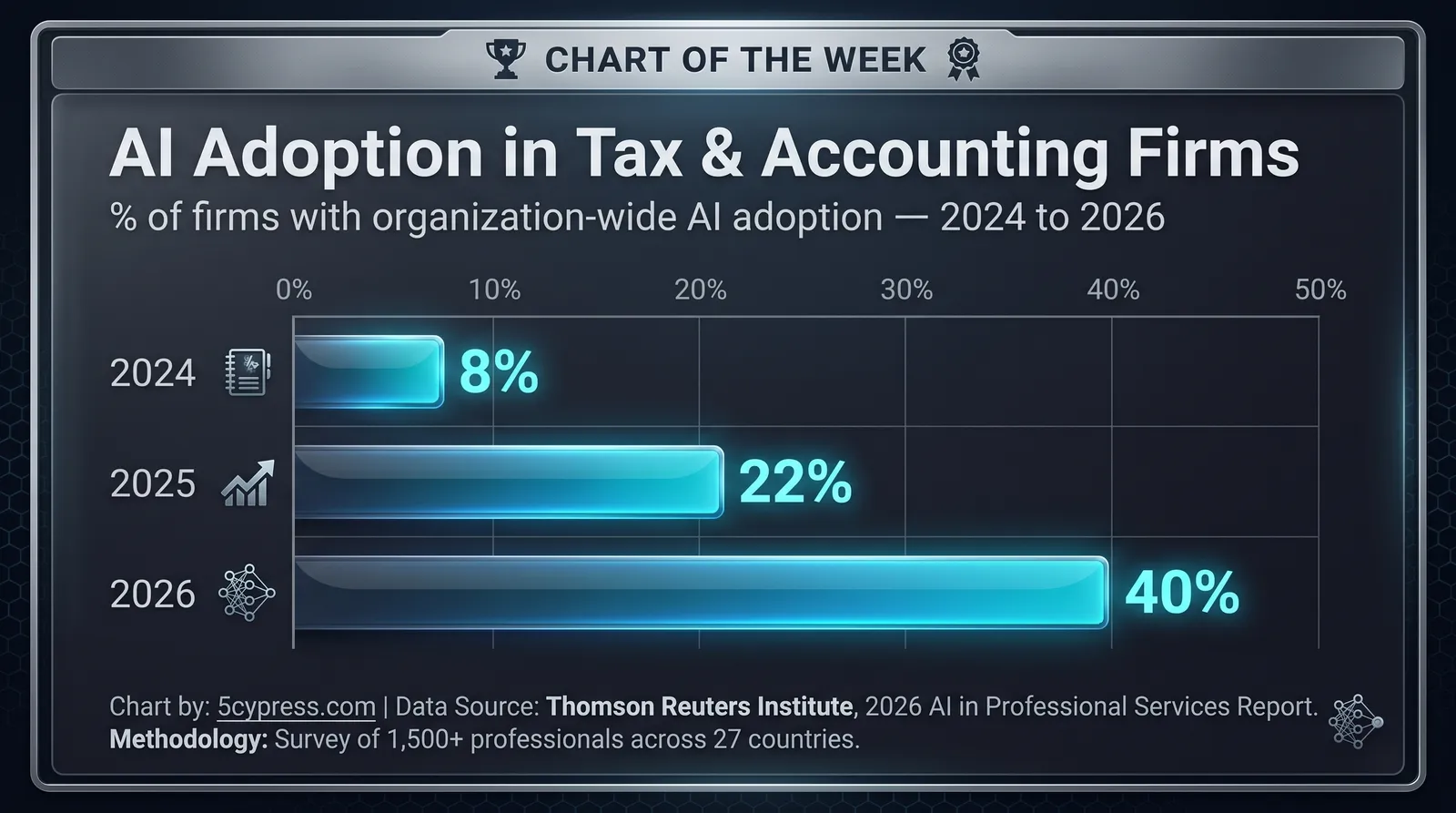
Chart: 5cypress.com | Data: Thomson Reuters Institute, 2025 survey of 1,700+ tax professionals.
Tax Research, Advisory, Document Work: Where GenAI Is Landing Inside the Job
The 2025 Thomson Reuters survey of 1,700+ tax professionals showed where AI was landing inside the actual job. Six task categories. All above 50%.
Tax research led at 77%. Tax advisory — the part of the job that's supposed to require human judgment — came in at 62%. Document review was lowest at 53%. That spread was tight for a technology most firms hadn't deployed two years before.
The 2026 data doesn't re-run that task breakdown. What it shows is depth: 44% of firms that have adopted AI now use it daily. Another 29% use it weekly. The question shifted from "which tasks?" to "how embedded?"
If your firm still treats AI as an occasional research shortcut, you're behind where most of your peers have already moved.
The Margin Gap: 23.8% EBITDA vs. 10.2% — and It's Growing
This is where the 2026 data gets specific.
Firms that have built AI into 80% or more of their projects average 23.8% EBITDA. Firms where AI is still peripheral average 10.2%. That's not a rounding difference. It's more than double the margin.
At a 20-person CPA firm doing $4 million in annual revenue, the difference between those two EBITDA figures works out to roughly $546,000 in annual operating margin.
The 2025 Thomson Reuters data pointed to $52,000 in annual value per professional at firms with a real AI strategy. The 2026 data shows what that looks like at the firm level. The gap is real and it's widening.
Only 18% of firms currently track any AI ROI at all. Most track operational metrics — cost savings, hours reduced. Almost none measure client satisfaction or revenue impact. A firm that isn't measuring can't see the margin gap. A firm that can't see it won't feel pressure to close it.
Put it in dollar terms: at a 20-person CPA firm doing $4 million in annual revenue, the difference between those two EBITDA figures works out to roughly $546,000 in annual operating margin. That's a number firm partners can take to a budget conversation.
The firms that feel this gap first are the ones competing for the same mid-market clients. When one firm can offer faster turnaround, cleaner work product and lower friction — and tie that to a documented AI workflow — the comparison becomes visible to clients in a way it wasn't two years ago.
68% of Accounting Firms Are Already Moving to Agentic AI
Fifteen percent of accounting firms have already adopted agentic AI tools. Another 53% are actively planning for them. That's 68% of the profession either in or moving toward agentic systems within the next year or two.
Agentic AI refers to systems that don't just answer questions or draft text. They take multi-step actions: running a workflow, flagging anomalies, updating a file, queuing a review for a partner. Firms building governance frameworks now — policies, review checkpoints, documented workflows — will have an easier transition. Firms that waited on basic AI policy will face the same gap again, one level up.
Ramp launched Stack in June 2026 as an early example of what purpose-built agentic AI looks like in accounting practice. It automates the monthly close, was tested on more than 200 accounting tasks by working accountants and makes every decision reviewable. More tools built specifically for accounting workflows — not adapted from general-purpose AI — are coming.
Why 75% of Firms Still Have No AI Policy After Three Years of Adoption
Because adoption moved faster than governance.
Wolters Kluwer's 2025 Future Ready Accountant Report found that 75% of accounting firms have no formal AI policy. That's close to the 70% Thomson Reuters found in early 2025. A year of rapid adoption didn't close the governance gap.
A staff member who pastes client tax data into ChatGPT counts as AI adoption. So does a firm with vetted tools, a documented review process and a clear data handling standard. Both show up in the same adoption numbers. Only one has a plan when something goes wrong.
Firms with written AI policies view the technology more positively — 84% compared to 44% at firms without one. That's not a coincidence. Policy turns scattered use into something you can build on and defend.
Three Things to Check Before the Next Busy Season
If your firm uses AI in any capacity, these are worth a look now.
Write down your AI policy. One page is enough. It needs to say which tasks are AI-assisted, what review happens before client delivery and how staff should handle client data in outside tools.
Find out what tools staff are actually using. Most firms learn their real AI stack through a short staff survey, not a memo. Ten minutes and a short form. What you find may change the conversation.
Check your E&O coverage. A growing number of malpractice carriers have updated their language around AI-assisted work. If you haven't asked your insurer about this in the past year, ask now.
Three-quarters of accounting firms still have no AI policy. A basic one-page document puts you ahead of most of your peers — and gives you something to build on when the agentic wave arrives.
Related on Nexairi
- Accounting Firms Need AI Standards Before AI Spreads
- AI Policy Template Rules for Small Accounting Firms
- Vendor Due Diligence Checklist for CPA AI Tools
- Crypto Brokers Filed Wrong Cost Basis. IRS Notices Are Going Out. — CP2000 exposure, 1099-DA mismatches and what CPAs need to do before the notices arrive
Free Assessment
Is your firm ready for AI?
A 5-minute governance check for CPA firms using ChatGPT, Copilot or AI accounting software. Get your score and your top gaps — free.
Sydney Smart is a Certified Public Accountant, Fractional CFO, and Controller with over 17 years of experience across public accounting and corporate finance. She holds a Master's degree in Taxation from Georgia State University, is a licensed CPA through the Georgia Society of CPAs, and is a certified QuickBooks Pro Advisor. Sydney spent 13 years as a Senior Tax Manager at Hungeling CPA preparing and reviewing hundreds of tax returns annually for corporate, partnership, and individual clients before moving into corporate controller roles. As Founder of Simply Smart Consulting, she partners with founders and growth-focused businesses to build financial systems that scale — budgeting, cash flow forecasting, GAAP compliance, and real-time KPI reporting. She reviews Nexairi's accounting and finance coverage to ensure accuracy for the CPAs, CFOs, and operators who rely on it.